TERA Gallery - African Art and Antiquities "Altering The Way You View The World Of Art" |

Type of Object:
Ethnic Group:
Country of Origin:
Material:
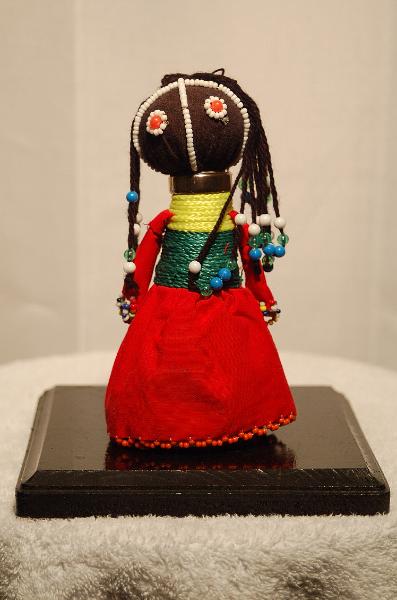
- Ndebele Doll
- When the concept of "doll" is considered in the context of African
culture, they are usually not children's playthings, but rather objects
that are laden with ritual and religious associations within the
community. African dolls are used to teach, and entertain, they are
supernatural intermediaries, and they are manipulated for ritual
purposes.
The Ndebele are one of the smallest cultural societies living in
northeast South Africa in an area called the Transvaal or
KwaNdebele, northeast of the capitol, Pretoria. They were
originally part of the migration of Bantu cultural groups from
Central and East Africa into southernmost Africa around 300-400
AD. Their artistic culture is rooted in centuries of traditional tribal
customs.
The Ndebele are known all over the world for the intricate
geometric designs in their beadwork as well as their painted
houses. . Women are the supreme Ndebele artists and design
and paint the houses as well as creating the beadwork. Their
beadwork is made using many colors and designs similar to their
house paintings. Many beadwork pieces are interesting in that
the beadwork stands alone without backing sewn to it. The
weaving process is done by hand and there is no loom.
Ndebele women adorned themselves in a way that is an
immediate identifier of her age and marital status to anyone who
can read the "code". She wears her identity around her waist in
the form of an intricately beaded apron, and there are several
types. After marriage, dresses became increasingly elaborate
and spectacular. In earlier times, the Ndebele wife would wear
copper and brass rings around her arms, legs and neck,
symbolizing her bond and faithfulness to her husband, once her
home was built.
Ethnic Group:
- Ndebele
Country of Origin:
- South Africa
Material:
- Cloth
Beads
Wire