TERA Gallery - African Art and Antiquities "Altering The Way You View The World Of Art" |

Type of Object:
Deminsions:
Reference:
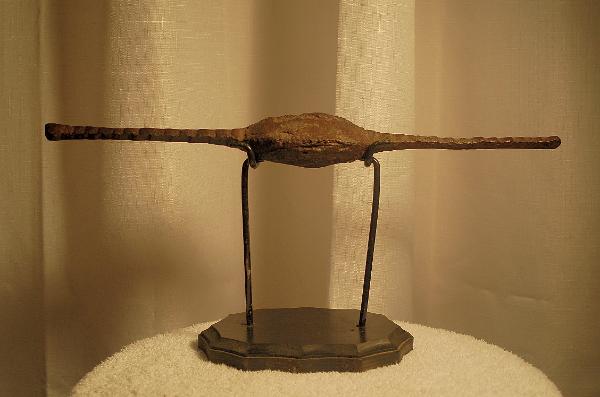
- Mumuy Tagere Currency
18 c.
- These forms, "tajere", pointed bars with globular mid-sections
were recognized and used as currency for rare but major
transactions throughout the different Nigerian districts, the shape
being one of the the few ways to distinguish origin since trade was
so widespread.
- These miscellaneously named "losol," "sasoreng," "tajere," or
"saka." Made by Batta and Mumuye peoples, who were subject to
the Fulani, northeastern. Iron currency rods were widely used
throughout the different Nigerian districts, the shape being one of
the few ways to distinguish origin since trade was so widespread.
The distinctive shape of the flat, expanded middle and slightly
twisted ends clearly indicate this as a piece of the Mumuye tribe
where they were carefully forged. The Fulani called these pieces
"losol" in the east and "tajere" or "taji" (plural) in the west, as did
the Batta and Mumuye to the south; today most people simply
refer to these old pieces as "Mumuye" currency. These rods were
ultimately used for making hoes or other implements, but they
were widely used for currency by both the non-Moslem tribes and
in the Muslim markets where the pagan tribes traded.
- Mumuye Society, Yoruba Society
Batta Society
- Nigeria, Cameroon
- Iron
Deminsions:
Reference:
- Quiggin, Alison Hingston. A SURVEY OF PRIMITIVE MONEY:
THE BEGINNINGS OF CURRENCY. Reprint. London: Spink &
Son, 1978. p87,plate1
- WESTERDIJK, H. Izerwerk van Centraal- Afrika. (Ironwork of
Central Africa) Rotterdam 1975. 154pp., 15b/w, 650 line, 3 maps.
Text: Dutch p134#E,F
- Roberto Ballarini, Ferrie Monete dell' Africa Equatoriale, Galleria
Africa Curio-Milano 1998. Pgs 37. p2
- Roberto Ballarini, Armi Bianche Dell'Africa Nera (Black Africa's
Traditional Arms), Africa Curio, Milano 1992.Pgs 128 p25#8
- Eyo, Ekpo. NIGERIA AND THE EVOLUTION OF MONEY.
Lagos: Central Bank of Nigeria, 1979. p52
- Tom Joyce, Univ. of NC exhibition. Life Force at the Anvil, The
Blacksmith's Art from Africa. Exhibition May - August 1998. Pgs
32 p22 figure 34